This section focuses on the “habits of hand,” or our ways of thinking and knowing in feminist pedagogy. What do we do? How do we act on our beliefs and values?
As a theory rather than a set of strategies, feminist pedagogy doesn’t “automatically preclude any technique or approach” (not even lecture) but instead highlights “the relationship that specific techniques have to educational goals” (Shrewsbury 14). In other words, its habits of hand take many forms, though they all express its habits of head and heart–an alignment that helps us maintain a critical awareness of our actions and a commitment to our goals. This intentional alignment occurs from the macro level (course design, learning environment) to the micro (specific classroom activities and assignments). See the pages below to learn more.
Framework for This Guide
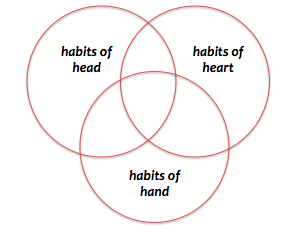
In addition to the feminist assumptions we spell out in our introduction, we also bring an important assumption about teaching that serves as the framework for this guide. Namely, we should try to align our practices with our values and beliefs–what Lee Shulman calls “habits of hand” with “habits of heart and head” (56).
- Habits of head are our ways of thinking and knowing.
- Habits of heart are the values that guide us.
- Habits of hand are our practices, informed by our habits of head and heart.
The three aren’t completely independent of the others. Instead, they are interlocked and overlapping.
This framework comes from Lee Shulman’s notion of “signature pedagogies.” For more, read Lee Shulman’s “Signature Pedagogies in the Professions” or Nancy Chick, Aeron Haynie, and Regan Gurung’s “From Generic to Signature Pedagogies.”

