Recent Publications
What have I been up to lately? See some highlights below. ~Nancy
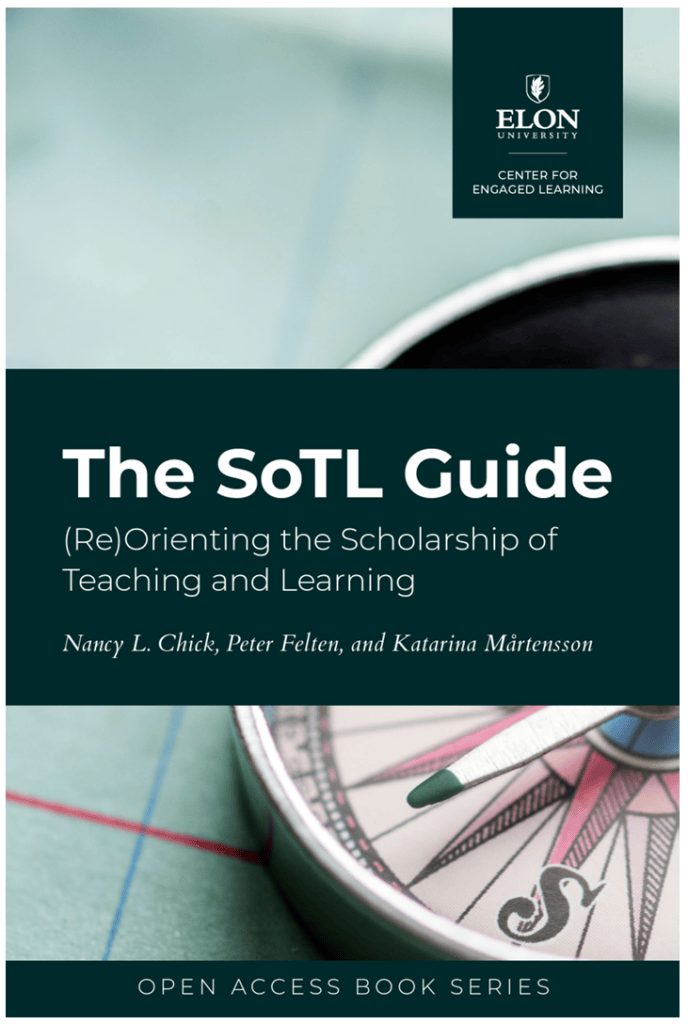
The SoTL Guide: (Re)Orienting the Scholarship of Teaching and Learning
Nancy L Chick, Peter Felten, & Katarina Mårtensson
“We wrote this book because we have a vision for SoTL to be an even more positive force in higher education—for those of us who teach and work in academia, for our students, and for our communities. Our definition of SoTL may be simple, but our vision for SoTL is ambitious. We see SoTL as more than one thing: it’s a practice that improves teaching and learning in context. It’s also a field that extends how we in higher education build knowledge. It’s a community that offers rich relationships for those who seek them. And it’s a form of scholarship with socially conscious and humane roots that call on us to make a difference in the education of students, in the careers of academics, and in the world.”
[Read The SoTL Guide, freely available online as part of Elon University’s CEL Press Open Access Book Series. You may also purchase a hard copy. ]
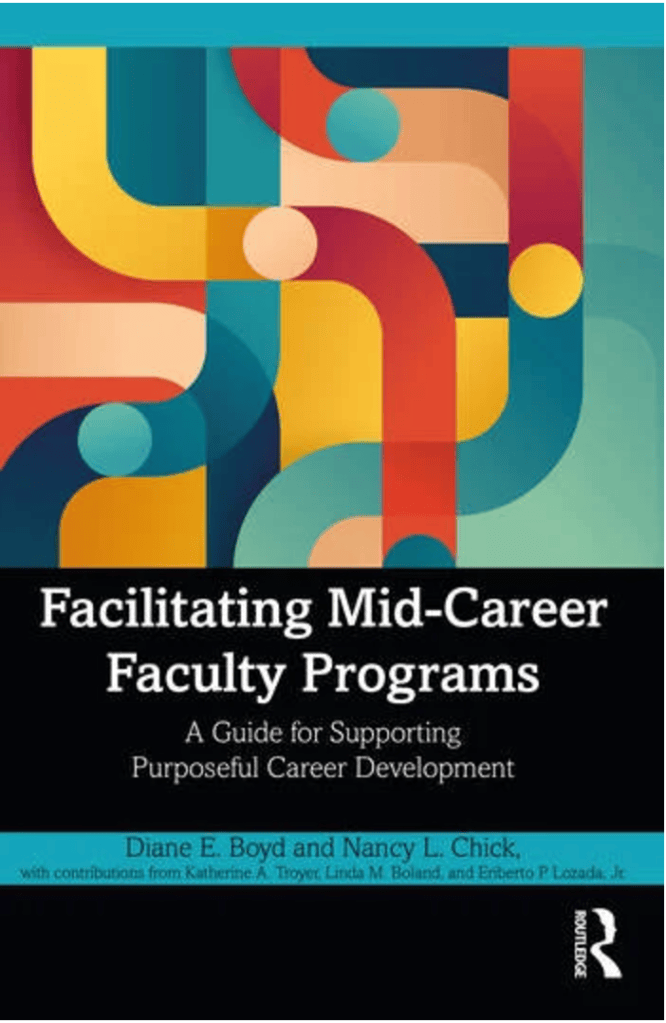
Facilitating Mid-Career Faculty Programs: A Guide for Supporting Purposeful Career Development
Diane E. Boyd and Nancy L. Chick, with contributions by Katherine A. Troyer, Linda M. Boland, and Eriberto Lozada Jr
“This book began in Zoom. In February 2021, we were in a virtual meeting of faculty developers from campuses in the Associated Colleges of the South (ACS), a consortium of 16 small, private liberal arts colleges. Most of us were doing this work on our campuses alone or in very small centers for teaching, and we were in the throes of pandemic pedagogy. All year, we’d been hustling on our campus’s frontlines as we tried to help faculty figure out how to teach in ways that they’d never taught before. By this time, however, the academic year was coming to a close, and we took a moment to step back and reflect on the ongoing challenges we’d observed on our campuses. After the initial check- ins, the meeting began with the consortium’s hallmark question, ‘What can we do together that we can’t do individually?’ Diane, whom we came to call ‘our fearless leader,’ unmuted herself and answered, ‘Support our mid- career faculty!’”
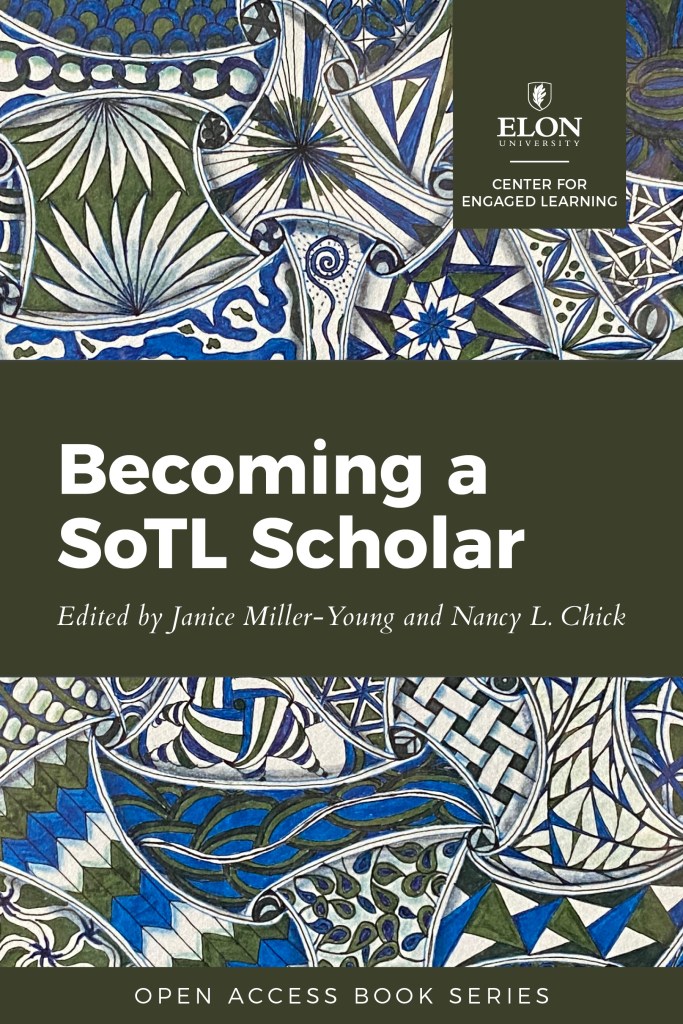
Becoming a SoTL Scholar
Edited by Janice Miller-Young and Nancy L Chick
“We have specifically chosen the word ‘Becoming’ for the title of this book to acknowledge that no matter where one is in their identity trajectory(ies), one is always in a state of learning and therefore, becoming. Identity is re-negotiated each time one engages in a new community where one is compelled to reflect upon how one’s previous competencies and identities can be translated (or not) into the new setting (Wenger 2000). One has to decide whether one is on ‘a journey to the heart of the community or as a visitor, a sojourner whose identity is primarily anchored elsewhere’ (Fenton-O’Creevy, Dimitriadis, and Scobie 2015, 33). Thus, becoming a SoTL scholar often involves reckoning with one’s academic identity in multiple and complex ways, and depends upon, among other factors, one’s motivations and goals for engaging in SoTL, institutional context, research experience, and disciplinary training.”
–“Developing Sustained SoTL Journeys and Identities” (Chapter 1) by Janice Miller-Young and Nancy Chick
[Read the book, freely available online thanks to Elon University’s CEL Open Access Book Series. You may also purchase a hard copy.]
Listen to our interview on the Tea for Teaching podcast.
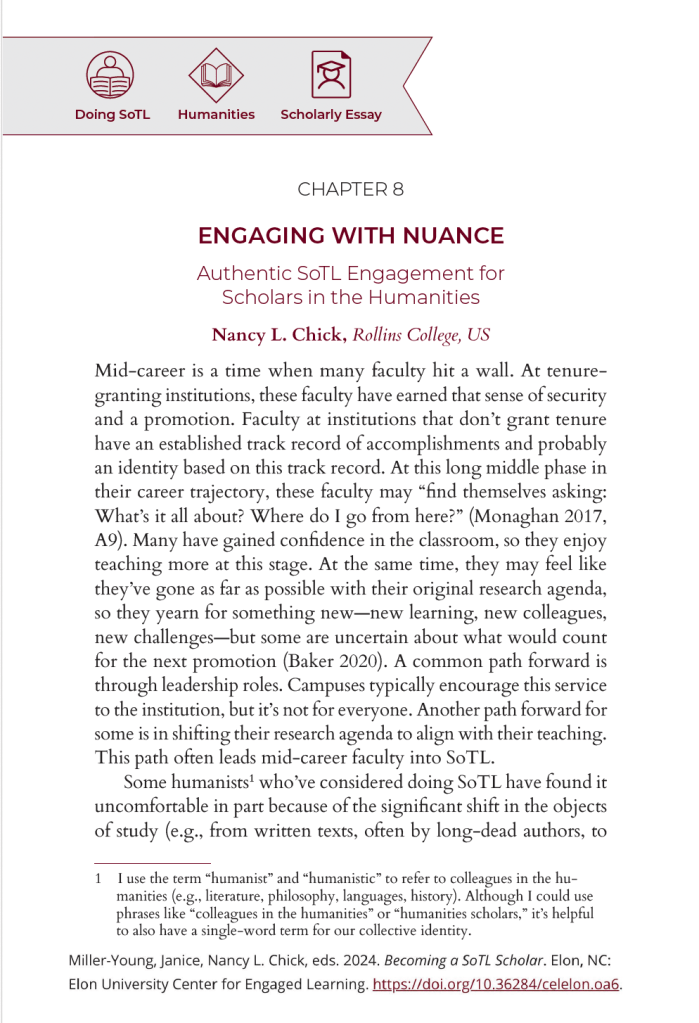
“Engaging with Nuance: Authentic SoTL Engagement for Scholars in the Humanities”
Nancy L. Chick
“I want to help interested colleagues in the humanities embrace SoTL as an integral part of … their careers while remaining authentic to their disciplinary expertise and epistemology…. My second goal serves the first. A decade ago, Gary Poole encouraged faculty working together across disciplines to navigate the ‘challenge of translating disciplinary research languages and of understanding research cultures’ by starting at ‘square one’: reflecting on and articulating an answer to the question, ‘what is research?’ (2013, 136) My third hope, then, is to support my colleagues in the humanities as they respond to Poole’s question and communicate their authentic work in SoTL’s multidisciplinary spaces.”
[Read the chapter in Becoming a SoTL Scholar, freely available online thanks to Elon University’s CEL Open Access Book Series]
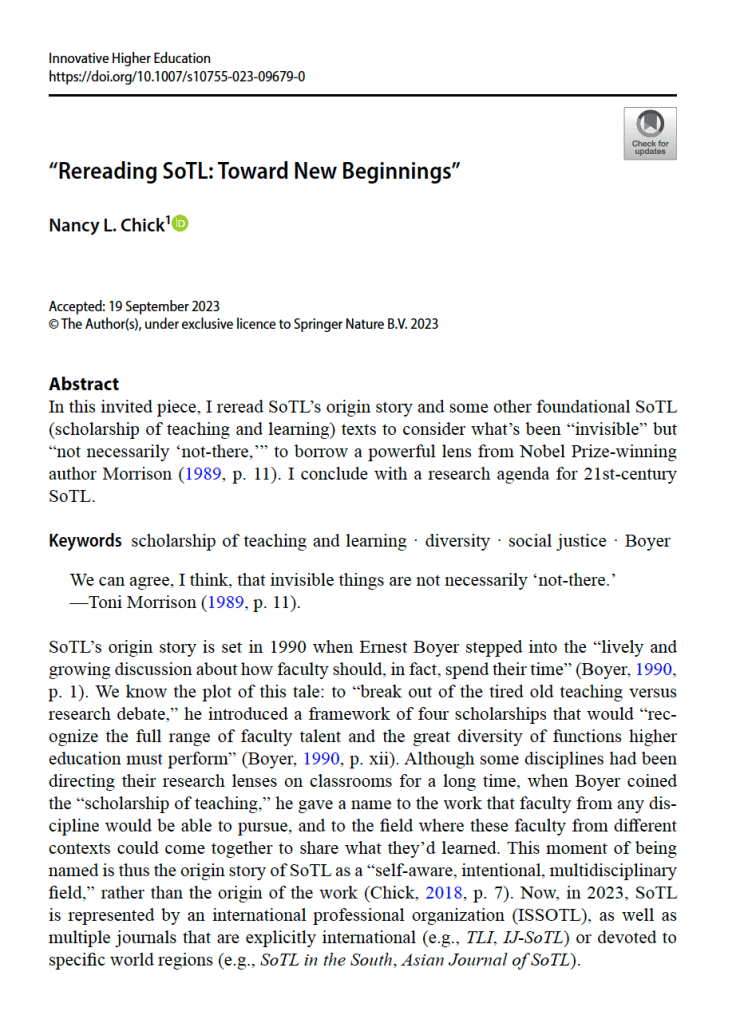
“Rereading SoTL: Toward New Beginnings”
Nancy L Chick
“We can agree, I think, that invisible things are not necessarily ‘not-there.’” —Toni Morrison (1989, p. 11).
“…. I just reread Boyer’s book, and I was drawn to parts of the text that are left out of this origin story, particularly the contexts and imperatives that are ‘invisible’ in the way we currently tell the story but are not ‘”not-there”‘ in the actual origin…. [A]s I describe, teach, and support SoTL and bring new practitioners into the field, I now wonder how I’ve simply replicated SoTL-as-it-is, despite my own call for SoTL’s potential to effect real change. With these questions and concerns in mind, I decided to reread some of the canonical SoTL texts that followed Scholarship Reconsidered, starting with two that many of us frequently use at the start of new SoTL projects. ”
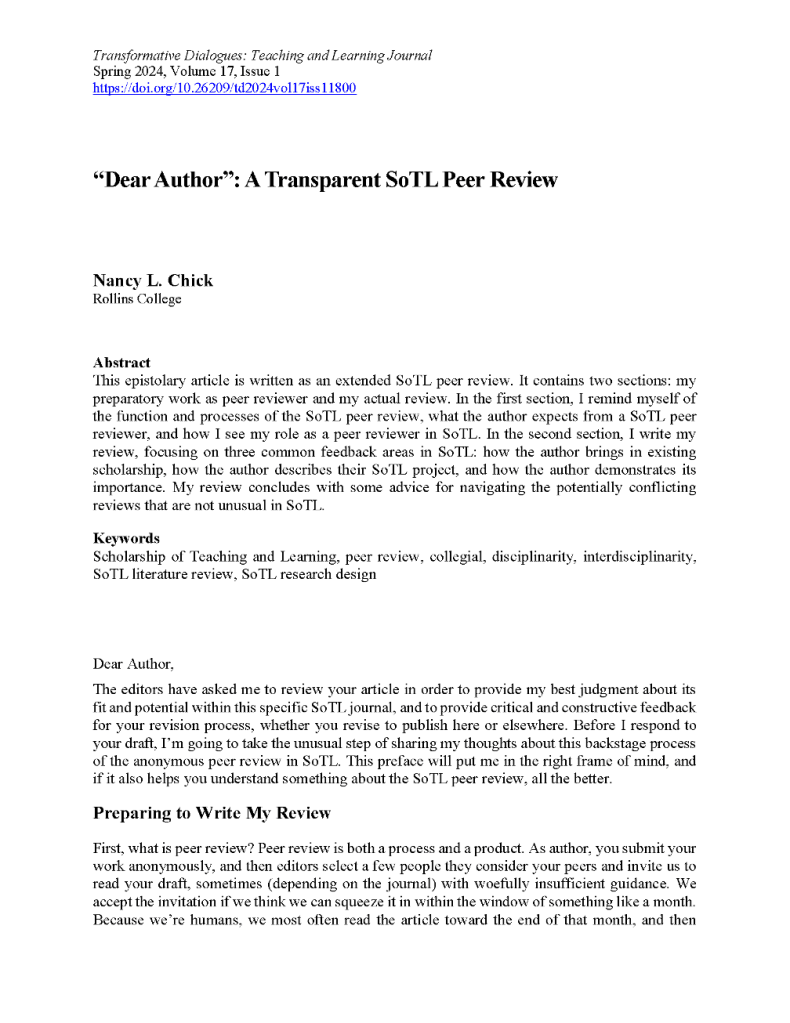
“‘Dear Author’: A Transparent SoTL Peer Review”
Nancy L. Chick
“…. Now, let me tell you how I see my role as a peer reviewer, or what I expect from me. Like everyone, I’m busy, so I have to set aside the time and mental capacity to be fully present when I read your draft. As a peer, I owe you that. As is often the case in SoTL, I’m reading your article from outside of your discipline. Also, even though we share the common language of English, I think I’m also located in a different country and within a different sociocultural context from your SoTL project. This means our educational systems and the larger political and cultural contexts for our work may have important differences, which may or may not be clear to me. I thus read your article from many ‘outsides’: I don’t know you or your project, I come from a different disciplinary background, and I’m in a different context. This is good. In these differences from you, I represent many of your readers in SoTL. The implications for me as your peer reviewer (and your SoTL colleague) are that I need to navigate these differences. Actually, I need to do more than that: I need to recognize, respect, and learn from them, and—in this role of peer reviewer—to remind you of them. For me (and eventually for your readers), this is challenging but necessary work in SoTL.” [Read the article.]
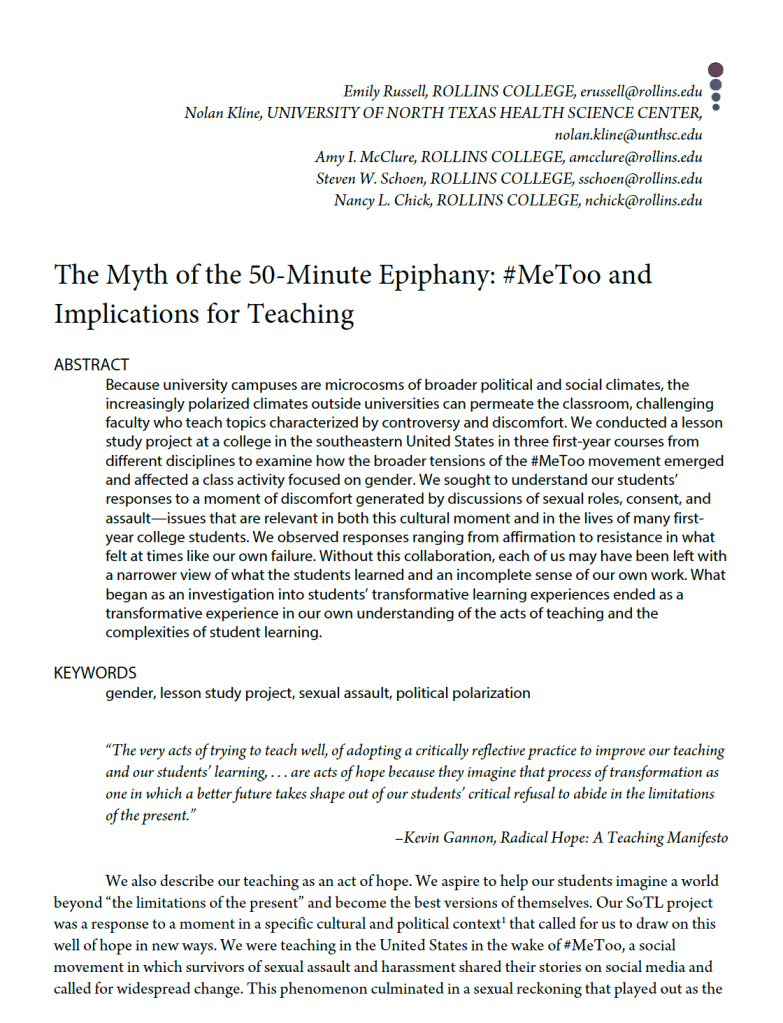
“The Myth of the 50-Minute Epiphany: #MeToo and Implications for Teaching”
Emily Russell, Nolan Kline, Amy McClure, Steve Schoen, & Nancy Chick
“We conducted a lesson study project … to examine how the broader tensions of the #MeToo movement emerged and affected a class activity focused on gender. We sought to understand our students responses to a moment of discomfort generated by discussions of sexual roles, consent, and assault issues that are relevant in both this cultural moment and in the lives of many first-year college students. We observed responses ranging from affirmation to resistance in what felt at times like our own failure. Without this collaboration, each of us may have been left with a narrower view of what the students learned and an incomplete sense of our own work. What began as an investigation into students’ transformative learning experiences ended as a transformative experience in our own understanding of the acts of teaching and the complexities of student learning.”
Editing
Some of my favorite work is editing, which is ultimately about showcasing other people’s great ideas. This kind of work is part of my “ethos of attribution,” which I explained in this blog post.
Editing Books
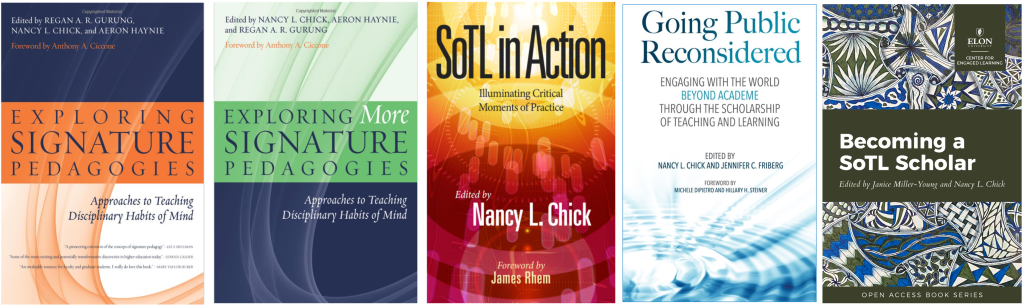
As of November 2024, five of my edited and co-edited books have been published. More are on the way.
Editing Journals
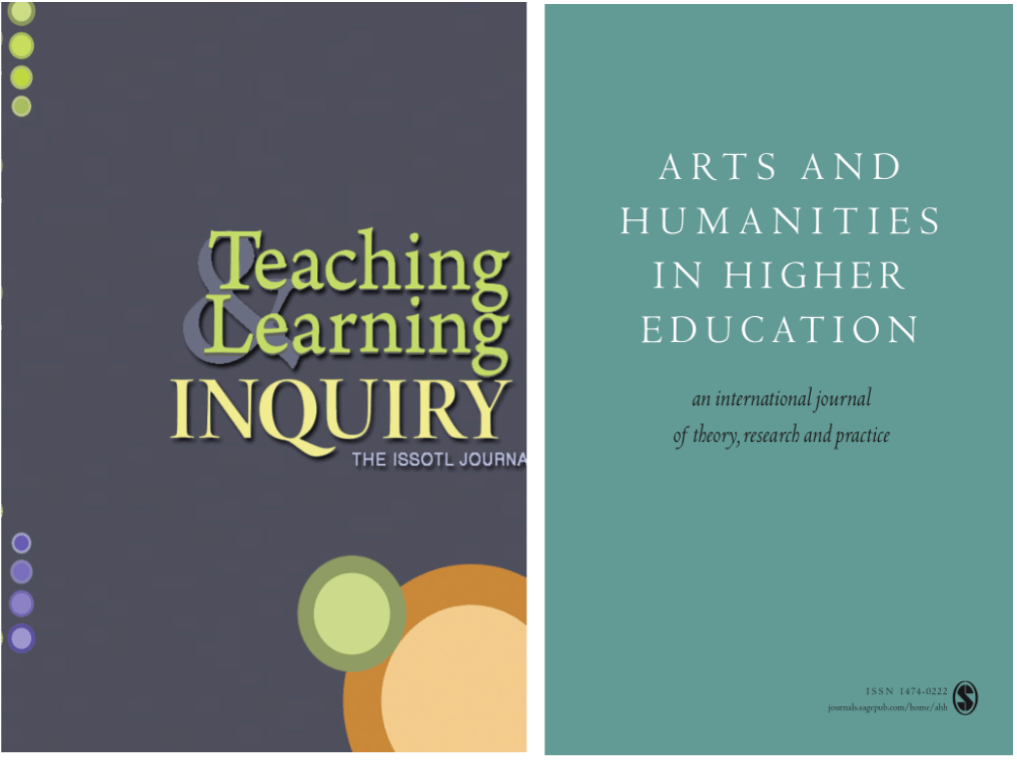
I co-founded Teaching & Learning Inquiry (the journal of the International Society for the Scholarship of Teaching and Learning/ISSOTL) in 2011 and co-edited it until 2020, and guest co-edited a special issue of Arts & Humanities in Higher Education in 2017.
What else?
Check out my CV, find me on the common citation aggregation cites, or reach out through my contact form — all below.
My CV
Click here (or the image to the right)
to read my CV.